A Complete Safety Evaluation Report
When it comes to baby clothes and sensitive skin, detergent safety is non-negotiable. Babies’ skin is thinner, more permeable, and far more reactive than adult skin, while people with eczema, allergies, or sensitive skin require extra-gentle laundry solutions.
In recent years, laundry detergent sheets have emerged as a modern alternative to liquid and powder detergents. But an important question remains:
Are laundry sheets really safe for babies and sensitive skin?
This article provides a professional safety evaluation of low-allergenic laundry detergent sheets, focusing on ingredient selection, formulation principles, and laboratory testing — helping parents, brands, and retailers make informed decisions.
Why Babies and Sensitive Skin Need Special Laundry Care
Infant and sensitive skin reacts easily to chemical residues left on fabrics. Conventional detergents may contain:
-
Artificial fragrances
-
Dyes and colorants
-
Optical brighteners
-
Harsh preservatives
-
High-alkaline surfactants
These ingredients can cause:
-
Skin redness and irritation
-
Contact dermatitis
-
Itching and dryness
-
Aggravation of eczema or allergies
That’s why baby laundry detergents and hypoallergenic washing products must meet much higher safety standards.
What Makes a Laundry Sheet “Baby-Safe” and Hypoallergenic?
Not all laundry sheets are created equal. A truly baby-safe laundry detergent sheet must be designed from the formulation stage with skin compatibility as a top priority.
1. Fragrance-Free Formula
Fragrance is one of the top causes of skin sensitization. Even natural essential oils can trigger reactions in babies.
✔ Baby-safe laundry sheets are completely fragrance-free
✔ No synthetic perfume
✔ No masking agents
This makes them ideal for newborn clothes, bedding, and underwear.
2. No Dyes or Colorants
Color additives serve no cleaning purpose — they are purely visual. For sensitive users, they add unnecessary risk.
✔ Dye-free formulation
✔ Clear or naturally white detergent sheets
✔ No color transfer to fabrics
3. Free from Optical Brighteners (Fluorescent Whitening Agents)
Optical brighteners remain on fabric after washing and reflect UV light, making clothes appear whiter — but they are known skin irritants.
✔ No fluorescent whitening agents
✔ No residue build-up on baby clothing
✔ Safer for long-term skin contact
4. No Harsh or Irritating Preservatives
Many liquid detergents require strong preservatives due to their water content.
Laundry sheets, however, are water-free products, which allows them to avoid:
-
MIT
-
CMIT
-
Formaldehyde releasers
✔ Preservative-minimal or preservative-free
✔ Reduced allergy risk
Mild Yet Effective: How Do Low-Allergen Laundry Sheets Clean?
A common concern is whether gentle laundry sheets can still clean effectively.
The answer lies in balanced surfactant systems.
Mild Surfactants Used in Hypoallergenic Laundry Sheets
Baby-safe laundry sheets typically use:
-
Plant-derived non-ionic surfactants
-
Low-irritation anionic surfactants in controlled ratios
These surfactants:
✔ Remove sweat, milk stains, and light food residue
✔ Rinse clean without residue
✔ Maintain fabric softness
No aggressive alkaline boosters are required.
Safety Testing and Evaluation Standards
To support safety claims, professional laundry sheet manufacturers conduct third-party laboratory testing.
1. Skin Irritation Test (Patch Test)
-
Conducted on human volunteers
-
Measures redness, itching, and irritation
-
Results typically show “Non-Irritating” or “Mild/None”
2. Hypoallergenic Assessment
-
Evaluates allergenic potential
-
Suitable for sensitive skin populations
-
Often follows dermatological testing protocols
3. Heavy Metal & Toxic Substance Screening
-
Lead, mercury, arsenic
-
No detectable harmful substances
4. EU & International Compliance
Many baby laundry sheets comply with:
-
EU Detergent Regulation
-
REACH standards
-
CPSR / Safety Assessment for export markets
Why Laundry Sheets Are Safer Than Traditional Detergents
Compared with liquid or powder detergents, laundry sheets offer structural safety advantages:
✔ Precise Dosage
-
No over-pouring
-
Reduces residue left in fabric
✔ No Liquid Spills
-
Eliminates accidental skin contact with concentrated detergent
✔ Faster Dissolution
-
Fully dissolves in water
-
No detergent clumps trapped in fibers
Ideal Use Scenarios for Baby & Sensitive Skin Laundry Sheets
Low-allergenic laundry detergent sheets are especially suitable for:
-
Newborn and infant clothing
-
Baby bedding and blankets
-
Cloth diapers
-
Underwear and intimate apparel
-
Sensitive skin adults
-
Allergy-prone households
What Parents and Brands Should Look For
When choosing or developing a baby-safe laundry sheet, check for:
-
Fragrance-free labeling
-
No dyes, no optical brighteners
-
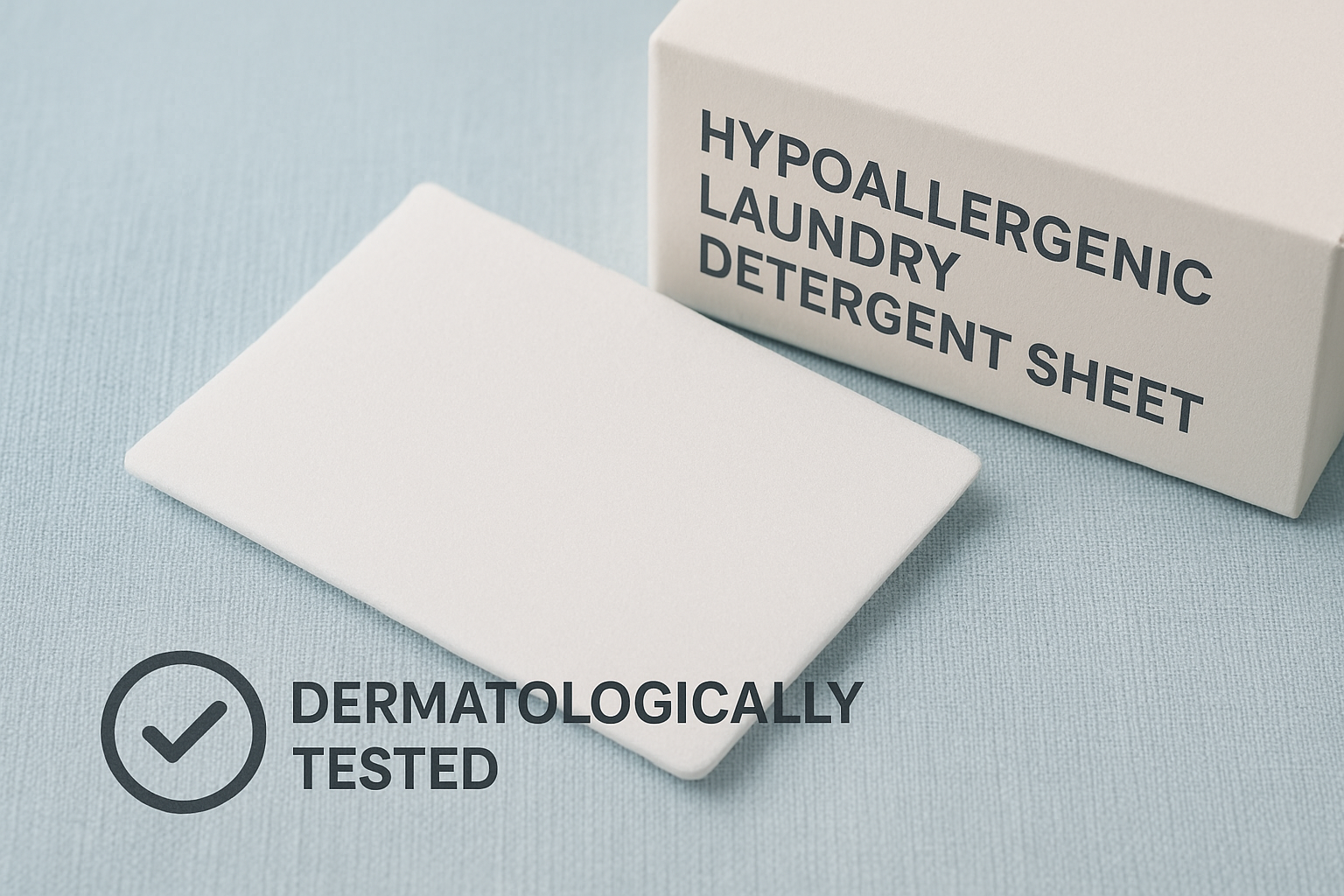
Dermatologically tested claims
-
Transparent ingredient disclosure
-
Third-party test reports
For brands, offering hypoallergenic laundry sheets helps build trust and long-term customer loyalty.
Conclusion: Are Laundry Sheets Safe for Babies and Sensitive Skin?
Yes — when properly formulated and tested, laundry detergent sheets can be one of the safest laundry solutions for babies and sensitive skin.
With fragrance-free, dye-free, and low-irritation formulations, combined with professional safety testing, modern laundry sheets deliver:
✔ Gentle care
✔ Reliable cleaning
✔ Peace of mind for families
As demand for clean-label, skin-safe laundry products continues to grow, baby-safe laundry sheets are becoming a preferred choice worldwide.